Monthly Archives: January 2008

What a wonderful opening paragraph!

I found the following article on-line thanks to Google News:

How corrupt are the Democrats with the Mormon Mafia/CIA?

For many years I have warned members of the Mormon Church about secret operations the CIA uses through foreign returned LDS missionaries in controlling every day life throughout the world. The only location not under the control of the Mormon Mafia is the US general public. Americans still believe Mormons are a cult. Since the days of Brigham Young and the announced “Utah War” in 1857 after Albert Pike and the Freemasons (including Heber C. Kimball and BYoung) murdered Mormon Apostle Parley P. Pratt near Fort Smith, Arkansas (9/11/1857 Mountain Massacre beginning event) the One World Order group has (money-changers) failed to destroy the US of A. The following special question given to the three leading Democrat candidates in New Hampshire, plus a recent exposed Democrat letter reflect how corrupt politics has become…

Each time I re-read this paragraph, I keep thinking: there’s a wonderful alternative-history novel in there somewhere. There may even be a coherent and logical train of thought in there, though I have less hope of that; as far as I can tell, just about every sentence (and the occasional individual clause) is a non sequitur to all that precedes it, which itself is a pretty amazing accomplishment.

However, the truly remarkable thing is that the rest of the article, which is quite lengthy, never again mentions Mormons or the LDS Church, which makes the title and opening paragraph even more mystifying — but not as mystifying as to why Google News accepts that web site as a news source. YMMV. ..bruce..

[Note for puzzled readers: “YMMV” is not the Mormon Tetragrammaton. It’s a well-known ‘net acronym for “Your mileage may vary.”]

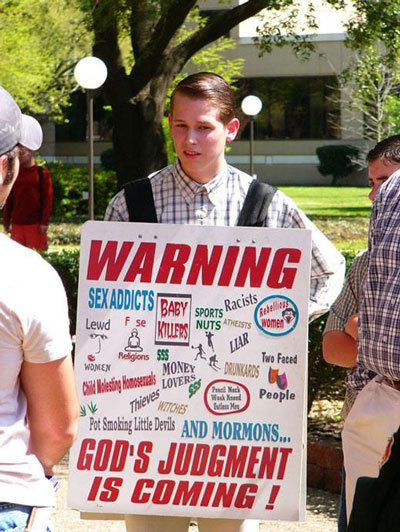
[And just because I like it so much, I’m putting up this picture again:

Now I'm worried

The photo originally came from here. ..b..]

Stewardship, accountability, and community response

[NOTE: I originally wrote this essay back in 1994 for Vigor, an LDS samizdat put out for several years in the 90s by Orson Scott Card. Given some of the discussions making the rounds in LDS blogs, I felt it’s still as timely now as it was back then. It is reproduced here — with just a few additions, all in brackets and italics — by permission.]

I’ve followed with interest and not a little dismay the increasingly strident discussions in various forums of how to deal with the imperfections of Church leaders. On one side are those who claim for Church leaders an infallibility and wisdom which they do not claim for themselves. On another side are those who feel that a “community response” — full-page newspaper ads, press conferences, public seminars and printed articles (often with scathing criticism) — is right and necessary. [I might add “LDS blogs” in here as well.]

When you have two (or more) sides of an argument going around and around without resolution, it’s usually due to conflicting unstated premises. The key issue, largely unvoiced, is this discussion: to whom is a person with a given stewardship accountable? Is it the people over whom he or she (“he” hereafter, just to save typing and since we’re mostly focusing on priesthood leaders) has a stewardship? Is it the person or group of people for whom he is a steward? Is it both, and if so, how does he resolve conflicts between the two demands?

My personal belief is that someone with a stewardship is accountable solely to the person or people for whom he is a steward. In some contexts, that may well be the people over whom he has a stewardship, for example, an elected official is accountable to those who elected him. In the context of the Gospel and the Church, that is rarely the case; none spring to mind, but I won’t flatly exclude the possibility. The bishop of my ward is responsible for the welfare of its members, but is not accountable to them (myself included). He is accountable to the one who gave him his stewardship, namely the Savior, and to any of Christ’s representatives who have stewardship over him, such as the stake president. That stewardship moves up the priesthood line authority to the general authorities, who are all directly or indirectly accountable to the First Presidency; the First President’ counselors are accountable to him, and the First President is accountable only to Christ.

Given my stated premise about stewardship, we can now look at the key issue: if I think someone with stewardship over me (or even not over me) is in error, how do I handle it?

If the bishop acts in a manner which I feel significantly conflicts with his stewardship, my first responsibility is to approach him directly and privately discuss it. If that doesn’t resolve things, I have the opportunity — and, in some cases, the responsibility — to inform the stake president. Likewise, if I judge my stake president to be in error, I can deal with him directly, and if that doesn’t resolve things, inform the general authorities of the Church; the exact channel may depend upon the issue. If I judge a general authority to be in error, I can address my concerns directly to him; lacking satisfaction, I can then go to the First Presidency. And if I think they’re messing up, I can take things right to God. (Actually, I can do that in any situation, but since He’s appointed earthly stewards at all other levels, I figure He expects me to use them when appropriate.)

In this context, it’s interesting to note that we have the Lord’s promise that He will never let the President of the Church lead us astray; we have no such promise for any other church leadership position, so obviously the Lord expects us to use these checks as needed

What is critical in this process is that it should be done with the same confidentiality, sensitivity, understanding, patience and forgiveness — in short, the same Christ-like behavior — with which we would desire our own imperfections and errors to be handled. The Savior taught that “if they brother shall trespass against thee, go and tell him his fault between thee and him alone; if he shall hear thee, thou has gained thy brother.” (Matt 18:15) The Savior goes on to say that if that brings no results, we should inform the Church — which I would interpret as meaning the appropriate divinely-appointed stewards, not our circle of friends, the members of our ward, or the readership of Sunstone and Dialogue [not to mention the entire Internet]. We would probably be outraged, and rightly so, if we found that a church member — much less a church leader — was publicly criticizing our performance in our church duties; we’d even be upset over private criticism, if it was shared with those not involved in the situation. Yet all too often, we feel little compunction — and, worse yet, a great deal of self-righteous satisfaction — about doing the same, whether privately, over the net, in print, or even over the pulpit or lectern.

Given the above, the idea of a “community response” to the statements, decisions and actions of church leaders is as appalling and inappropriate as would be a “community response” — complete with private discussion and correspondence, newspaper ads, public lectures and published articles — as to how well any one of us is carrying out his or her stewardships within the Church and within his or her family. It ignores the dignity of the individual, and commandments toward charity, tolerance and forgiveness, and the channels which the Lord set up to deal with these issues. I suspect the Lord will not justify us in such a course, and that — whatever the errors of those we criticize — upon us will remain the greater condemnation.

Bruce F. Webster [Vigor, Issue 5, August 1994]
Ignorance at work

UPDATED 01/12/07: A more general critique of Feldman’s article can be found over at GetReligion.

Noah Feldman, in today’s New York Times Magazine, puts forth a thesis about “Mormon secrecy” that just is ill-informed. Feldman clearly has access to certain bits of historical information about the Church, but in his effort to establish his main thesis — that the LDS Church is committed to “secrecy” regarding its beliefs — he displays a significant lack of knowledge about the Church itself. To wit:

Like Mormon ritual, much of Mormon theology remains relatively inaccessible to outsiders. The text of the Book of Mormon has always been spread to a broad audience, but the text is not a sufficient guide to understanding the details of Mormon teaching. Joseph Smith received extensive further revelation in the nature of sacred secrets to be shared with only a handful of close associates and initiates within the newly forming church.

First, of course, is the long-standing issue (within LDS circles) as to whether a “Mormon theology” even exists (since, for the most part, there are no “Mormon theologians” nor a “school of Mormon theology”). But setting that aside, I would suspect that Feldman has not spent much time inside an LDS church or a Deseret Book bookstore; I suspect that he has not searched the online “Gospel Topics” section at LDS.org, nor its on-line “Gospel Library“, including archives of LDS General Conference Addresses, various current lesson manuals, and the online version of The Encyclopedia of Mormonism. All these are freely and publicly available to anyone; indeed, the Church works very hard to promote all these sections. In short, while claiming an LDS effort at doctrinal secrecy, he appears to have failed to actually reviewed what the LDS Church says and promotes about its own doctrine.

He also appears to gloss over the fact that the LDS Church has sent out over one million missionaries to preach its message of the Restoration since its founding in 1830, with over 50,000 serving worldwide currently. My experience is that most people outside of the LDS Church complain that we try to tell them too much about our religion, rather than too little.

Beyond that, Feldman’s particulars regarding “Mormon secrecy” — a concept that comes straight out of evangelical anti-Mormon literature — are wrong and could have been easily refuted had he bothered to do a modicum of research. For example, he states:

The course was set for the Mormon religious practice of the 20th century: a process of mainstreaming, both political and theological. The less said the better about the particular teachings of the church, including such practices as the baptism of the dead and the doctrine of the perfectibility of mankind into divine form.

Actually, those two “particular teachings” have always been a key part of the missionary discussions (under “Plan of Salvation”), at least since I served my own full-time mission back in 1972-74. If Feldman had actually looked through Preach My Gospel, the standard LDS missionary discussion guide used by 50,000+ LDS missionaries in teaching investigators worldwide — publicly and cheaply ($6-$9) available via LDS Distribution Services, Deseret Book, and the BYU Bookstore, as well as downloadable as a free PDF file — he would have found the following:

The Savior loves all people and desires their salvation. Yet millions of people have died without having any opportunity to hear the message of the restored gospel of Jesus Christ or receive saving ordinances. Through His loving grace and mercy the Lord makes salvation possible for everyone who did not have the opportunity to receive, understand, and obey the gospel during their mortal lives. The gospel is preached to those deceased people in the spirit world. Members of the Church on earth perform the saving ordinances in behalf of their deceased ancestors and others. Deceased persons living in the spirit world have the opportunity to accept or reject the gospel and the ordinances performed in their behalf.

For this reason, Church members search for information about their ancestors. They complete pedigree charts and family group records and submit the names of deceased relatives who need to have saving ordinances performed on their behalf in sacred temples, This is family history work. Worthy members ages 12 and over, including new members, may receive from their bishop a recommend to perform baptisms for the dead. (p. 86)

And again:

Those who have repented of their sins and received the ordinances of the gosepl and kept the associated covenants will be cleansed by the Atonement of Christ. They will receive exaltation in the highest kingdom, also known as the celestial kingdom. They will live in God’s presence, become like Him, and receive a fullness of joy. (p. 53)

* Exaltation: Eternal life in God’s presence; to become like our Father in Heaven and live in His presence. The greatest of all the gifts of God. Exaltation comes through the Atonement of Christ and through obedience to all the laws and ordinances of the gospel. (p. 58)

So much for the “secret” doctrines.

Beyond that, Feldman appears to commit a version of the Pauline Kael fallacy (“How could Nixon have won? Nobody I know voted for him!”). He assumes LDS secrecy, probably because he — unlike literally millions and millions of people worldwide — has never actually had the missionary discussions, and he probably doesn’t know anyone who has, so he just doesn’t know what LDS missionaries actually teach. He takes the one area of LDS sacred ritual, the temple, and attempts to conflate it — without any real evidence or justification — into a general Mormon tendency towards secrecy. His unsupported (and unsupportable) thesis drives his article, when instead he should have done actual research first and spared himself some embarrassment.

I would recommend that Feldman pick up Preach My Gospel (or download the PDF version) as well as this year’s LDS Relief Society/Priesthood Study Guide, Teachings of the Presidents of the Church: Joseph Smith (also available on-line), and read them both. Then maybe he’ll be a bit more qualified to talk about LDS doctrine and its public availability. ..bruce..

[UPDATED 01/06/08 1922 MST — Welcome visitors from the Deseret News LDS Newsline! Feel free to look around. ]