Adventures in Mormonism

Correcting the incorrigible

Archive for the ‘Media’ Category

Jews’ covenant with God up for renewal

Posted by bfwebster on January 8, 2010
Posted under Humor, Media, World Religions

Ah, the Onion. Doing what SNL would do if they (SNL) had any decent writers or comedians left. ..bruce..

Why the Catholic Church is upset with “New Moon”

Posted by bfwebster on November 21, 2009
Posted under Main, Media, Movies, Traditional Christianity, World Religions

After having seen “New Moon” on Friday afternoon with my sweet wife Sandra, I was a bit startled in late night browsing to read the following article (hat tip to Big Hollywood):

The latest movie in vampire saga Twilight is a ‘deviant moral vacuum’, the Vatican said yesterday.

New Moon, which opens in Britain today, is a ‘mixture of excesses aimed at young people and gives a heavy esoteric element’, a spokesman added.

The blockbuster opened on Wednesday in Italy and took £1.8million at the box office.

Monsignor Franco Perazzolo, of the Pontifical Council of Culture, said: ‘Men and women are transformed with horrible masks and it is once again that age-old trick or ideal formula of using extremes to make an impact at the box office.’

Huh? “Deviant moral vacuum” for a series that gets mocked because of the lack of premarital sex among its youthful characters? And I’m not entirely sure what “heavy esoteric element” means or why it would be a reason to condemn a movie. After all, the Vatican (as far as I can tell) had nothing to say about “2012″ which actually depicts the violent death of the Pope and the rest of the Catholic Church leadership, along with hundreds of people being crushed by the collapse of St. Paul’s Basilica. Given all the films that are out there, with plenty of morally objectionable content, why would the Vatican choose to unload on “New Moon” of all things?

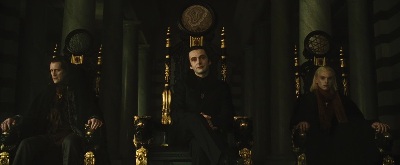
Then it hit me: the Volturi.

For those of you who haven’t read the series/seen the films, the Volturi are in effect the global rulers of all vampires and the only ones who can and do enforce (via death) a small set of rules — intended to keep the existence of vampires a secret — upon other vampires.

And, by the way, the Volturi live in Italy, where they rule from a large secret domed chamber. And they sit in throne-like chairs wearing formal antique clothing (see photo above).

Now, I don’t think that Stephenie Meyer had the Catholic Church in mind (at least, not consciously) when she invented the Volturi. The Volturi don’t act like religious leaders, and they don’t live in Rome but rather in Volterra (an actual small ancient town in the Tuscany region of Italy). But I suspect that someone at the Vatican saw the film, drew certain inferences, and was not happy, particularly given Meyer’s well-publicized LDS (Mormon) background. I also strongly suspect that if the Volturi had lived somewhere other than Italy that the Vatican would have had nothing to say about the film. ..bruce..

P.S. The movie itself? Meh. Better done than the first one, but the first 30-45 minutes seemed to drag. On the other hand, the 2nd book was the weakest of the four.

Mormons get the blame for Maine

Posted by bfwebster on November 5, 2009
Posted under Current events, LDS Society, Main, Media, Politics

Mollie over at GetReligion.org points out that in wake of Maine citizens overturning the gay marriage law (the Question 1 initiative before voters this past Tuesday), gay marriage supporters are now seeking to blame the LDS Church somehow:

Check out this paragraph in the Post story about the National Organization for Marriage:

Some groups for gays say the organization is a stalking horse for the Church of Jesus Christ of Latter-day Saints, or the Mormons, which dominated fundraising in the California campaign. Many of the actors in a nationally televised ad produced by NOM, called “Gathering Storm,” turned out to be Mormon activists.

Wow. Okay, so the allegation at play here is that the Mormons are deceiving everyone by operating this group without being up front about it. That is a very serious charge. Nowhere is it substantiated. I mean, I know that the National Organization for Marriage has at least one Mormon board member — Orson Scott Card. But he’s hiding in plain sight. I found out that information by surfing the NOM website myself. And what does it mean that “many” of the actors in a television ad “turned out to be” Mormon activists? I don’t even know what that means, although it does sound scary. What, exactly, is a “Mormon activist”?

I think they’re called Danites. ;-) ..bruce..

Did you know that LDS women “flock”, “swarm”, and “buzz”?

Posted by bfwebster on April 29, 2009
Posted under LDS Society, Main, Media, Politics, Press

This morning’s Salt Lake Tribune has the following story headline and opening sentence:

LDS women flock to upcoming BYU Women’s Conference

More than 20,000 Mormon women will swarm the campus of Brigham Young University next week, buzzing about mothering, marriage, the media and dozens of other spiritual and secular topics.

It prompted me to write Peggy Stack (the author of the piece) this e-mail:

“LDS Women Flock”? Would you (or the Trib) use that verb to describe (a) a NOW or Emily’s List conference,  (b) an LDS Priesthood conference, or (c) any non-religious gathering of men (or, for that matter, women)? The headline has a whiff of religious and/or sexist condescension. Same question for the use of the verbs “swarm” and “buzz” in the first sentence.

What do you think?  ..bruce..

“Could Pat Robertson Be Mormon?”

Posted by bfwebster on April 9, 2009
Posted under Belief systems, LDS Doctrine, Main, Media, World Religions

Paul Abrams over at the Huffingon Post has a snarky and somewhat ill-informed article in response to comments that Pat Robertston apparently made about heaven. To give you an idea of the silliness of Abrams’ piece, here’s an excerpt (the bracketed, italized section is in the original and seems to suggest that Abrams didn’t exactly quote Robertson accurately in the preceding sentence):

Without hesitating a nanosecond, Robertson half-chuckled his answer, telling the viewer in no uncertain terms that if he thinks he is just going to spend eternity lying in a lounge-chair on a cloud, well, he’s got another thing coming. The Lord has a lot of work for him to do, he might give him (the viewer) a planet to manage, there are 200-300 million of them. [Btw, this is not an exaggeration, Robertson actually talked about lounging on a cloud and millions of planets to manage, and lots of work the Lord has for him].

Robertson knows this (and all else) because, as you all know, once a year Robertson spends a day with the Lord. Now, I must admit that I have always found it curious that the Lord, who is the Lord of the entire universe, measures time-cycles by how long it takes for one of his stars, the sun, to orbit the Earth, oh, I mean the Earth to orbit the sun–sorry, I forgot that we have revised that certitude–but I am not surprised that the Lord created exactly one planet for every US citizen, so each of us knows that there is an eternity of work in Heaven (and, let’s face it, not all of you are going to get there, and some of you are illegal immigrants, and the Lord will be damned if those people are going to get a planet to manage!–although, Lord knows, they do work cheaply.). . . .

Come to think of it, God himself (or herself, or itself?) is not exactly doing a hot job of managing this planet, so how could lowly me, or even Heavenly me, be expected to do any better? We’ve got wars, piracy, diabetes, cancer, poverty, drug-resistant superbugs, John Boehner handing out tobacco-lobbying checks on the House floor, socialism and the prospect of Arnold Schwarzeneggar making another film when his time as Governor expires (can’t you get him a third term, or a US birth certificate—anything?).

Illegal immigration? US citizens only? I’m not sure how Abrams made that leap, particularly given the fact that — whatever criticisms I have of Evangelical Christianity — they are most definitely a world faith and do vastly more humanitarian work in developing nations than Abrams and his ilk ever dreamed of attempting. Abrams then goes on to point out that “I always thought that it was the Mormons who received planets to manage in Heaven”, making Robertson a “closet Mormon.” Abrams then decides that this means that Robertson must be planning to support Romney in 2012, after having supported Giuliani in 2008.

I think that Abrams was trying to write a witty, satirical piece, but mostly he comes across as someone who is mostly interested in scoring cheap laughs by mocking others without learning enough to say anything really clever or actually applying any semblance of logic to his leaps.

In the interests of full disclosure, I’ll note that I actually appeared once on “The 700 Club” and was interviewed by Robertson. It had to do with Year 2000 issues (I had testified three times before Congress on the matter and was working with Fannie Mae on its corporate-wide Y2K remediation efforts). That, of course, is not to be construed as an endorsement of or agreement with Robertson or “The 700 Club”, either their collective theology or their approach and operations, and I’m sure Robertson would feel the same about me. But at least in my experience he took the time to learn what he was talking about.  ..bruce..

LDS themes in Battlestar Galactica, Knowing, and Watchmen?

Posted by bfwebster on March 21, 2009
Posted under LDS Doctrine, LDS Society, Main, Media, Movies

SPOILERS BELOW! YOU’VE BEEN WARNED!

[NOTE: welcome to all the traffic from Twitter and from Roger Ebert's review of "Knowing"! I've expanded a few things below for clarification.]

I’m going to discuss religious themes, particularly as related to LDS beliefs and themes, as found in the movies “Watchmen” and “Knowing”, as well as in the finale of the TV series “Battlestar Galactica”. In doing so, I’ll freely discuss spoilers, at least in “Knowing” and BSG. You’ve been warned.

If you don’t want to read the spoilers, let me tell you that I strongly recommend the BSG finale (the whole series, really) and the movie “Knowing”. I haven’t seen “Watchmen” (though I’ve read the graphic novel several times over the years), but based on what I’ve read about the film, I don’t plan on seeing it.

Read the rest of this entry »

Mormon journalism — SL Tribune “Big Love” update

Posted by bfwebster on March 15, 2009
Posted under LDS Society, Main, Media, News, Press

[NOTE: I've made a few updates and edits below.]

I wrote yesterday about how the Deseret News has managed to actually increase its paid circulation by focusing more on a specific target audience — Mormons — while the Salt Lake Tribune declined in paid circulation at the same time.

This editorial choice at the Tribune certainly isn’t going to help matters much (the column is by Connie Coyne, the ‘Reader Advocate’ at the Trib; emphasis is mine):

I talked to many faithful LDS Church members this week after a story about “Big Love,” HBO’s polygamy drama, appeared in The Tribune alongside a photo of one of the characters wearing temple clothing known only to devout members of The Church of Jesus Christ of Latter-day Saints.

Trust me, Pandora’s box is ajar and the bad feelings are in the ether. . . .

By Friday afternoon, 1,111 readers had commented on the online version of the story at www.sltrib.com.

Although a tightly cropped version of the photo appeared in the print edition, the larger shot was pulled from the Web site and the photo archives as soon as Tribune Editor Nancy Conway saw it. She believes the photo added nothing to the story by Vince Horiuchi about the controversy surrounding the episode that airs Sunday evening. That episode reportedly will depict a rite that members consider sacred and private. . . .

But I can assure Mormons that The Tribune did not intend to offend members of the LDS Church. We should have more carefully considered what using the photos would mean to Latter-day Saints.

Yep, you read that right. The Tribune ran in its print edition and on its web site a photo (from “Big Love”) of an actress in LDS temple robes to accompany an article by Vince Horiuchi about the “Big Love” flap. (NOTE: it’s unclear exactly which article Coyne is talking about; I found three by Horiuchi on the “Big Love” flap [here, here and here], but none has the 1,000+ reader comments that Coyne references.  Of course, that raises the issue of whether the Tribune pulled down the corresponding reader comments after pulling the photo from the web site.)

I’m trying to figure out how Coyne can say with any credibility that the Trib‘s editorial staff “did not intend to offend members of the LDS Church” by running that photo.  It’s hard to see it as anything but a deliberate poke in the eye to Utah Mormons. It would be like running one of the (in)famous Mohammed editorial cartoons in a heavily Muslim city and then saying, “We didn’t intend to offend Muslims!” You may have editorial reasons for running the cartoon, but you can’t claim after the fact that you didn’t understand how it would upset people. (Note, however, that there have not been, to my knowledge, any death threats, fire bombings, or massive street demonstrations in the wake of the Tribune‘s actions.)

Note, by the way, that I think that the Tribune had every right (under the 1st Amendment, etc.) to run that photograph; in that, I happen to agree with Vince Horiuchi (though not with his snarky tone). But as we like to remind ourselves in the Church, you are free to choose your actions; you are not always free to choose the consequences.  And given the Tribune‘s circulation struggles, this may not have been the wisest course of action.  ..bruce..

Mormon journalism pays off

Posted by bfwebster on March 14, 2009
Posted under LDS Society, Main, Media, News, Press

Deseret News — Once upon a time the Deseret News, the Church-owned newspaper in Salt Lake City, carried on a highly entertaining feud with the anti-Mormon Salt Lake Tribune. In these calmer days, the Tribune and the News share the same adverstising office, cooperate on the Sunday edition, and never exchange so much as a snide word. Oddly enough, however, Mormons still get some small rebellious satisfaction out of subscribing to the Tribune, and non-Mormons regard the Church paper with suspicion.

– Orson Scott Card, Saintspeak: A Mormon Dictionary (Orion Books, 1981)

There was an interesting article by Paul Beebe in yesterday’s Salt Lake Tribune about the travails of the Tribune and the Deseret News in today’s tough market for newspapers. However, Beebe buried the real lede, and quite possibly deliberately.

You see, Joe Cannon at the Deseret News has adopted a concious approach to increase LDS coverage and utility to LDS readers, both in the print edition and online, since “research going back a decade shows little interest in the newspaper among non-Mormons” (as per Card’s quip above). Beebe focuses a lot on the internal controvery at the News over the decision, including staff protests and even some demotions:

Last month, 10 News reporters removed their names from stories they had written for the Feb. 23 paper to protest Editor Joe Cannon’s strategy to make the LDS Church-owned paper more pleasing to Mormons — and more profitable. Cannon sees the strategy as a way to allow two daily papers to remain viable in a market of Salt Lake City’s size.

The reporters were also protesting the demotion of two editors who objected to the paper’s drift.

What Beebe later acknowledges — though you have to get halfway through the article to find it out — is that:

Cannon’s strategy appears to be working. Paid circulation increased 2.1 percent in the six months ending Sept. 30. The News was one of a few big-city papers to add readers during the period, according to Audit Bureau of Circulations figures.

If you have been following newspaper journalism at all for the past few years, you’d know how remarkable that is. I’d be interested to find out what other “big-city papers” have increased in circulation during the last six months; most of the focus these days are on the ones that have already closed up shop (like my town’s own Rocky Mountain News) or are likely to do so soon. So the fact that the News increased its circulation, in a city as relatively small as Salt Lake and with another competing daily newspaper, is major journalistic news indeed.

Oh, and the Tribute, like most other newspapers around the country, lost circulation during the same period:

The larger Salt Lake Tribune is coping with circulation and advertising declines of its own. Paid readership dropped 5 percent in the six-month period, according to ABC. So far this year, revenue for both papers is down 20 percent.

Although the circulation losses are blamed on a cost-saving move to pull Tribunes from numerous hotels in Utah, editors see them as additional confirmation that the newspaper must branch into new areas if it is to keep its leading role.

So the question is: will Salt Lake City be a one-paper town (as Denver now is) in a few more years?  ..bruce..

New approaches to modern music: “Stairway to where?

Posted by bfwebster on January 28, 2009
Posted under Humor, Hymns, LDS History, Main, Media

First off, major props to Ardis “Ace” Parshall, Mormon Detective and blogger at the always-excellent Keepapitchinin, for her fast and (as usual) outstanding research work. Those of you who are familiar with her work on the Great Mormon Marijuana Myth know just what historical investigation skills she can bring to bear. That said…

Back in 1967, the LDS Primary (children’s) organization sent out to LDS wards and branches everywhere the program and materials for that year’s annual Primary Sacrament meeting (thank you, Ace, for tracking this down). The theme was “Stairway to Lasting Joy”, and the materials included the sheet music for a children’s hymn by that same name, with lyrics by Mabel Gabbott and music by Robert Cundick (who was organist for the Mormon Tabernacle Choir at the time). The hymn is interesting in that it’s written in a minor key and has a lyrical feeling to it; when the hymn was added to “Sing With Me”, the LDS Church’s hymnbook for the Primary organization, it included the notation “Moderately slow, smoothly (in the style of a folk song)”.

It really is beautiful; here’s a clip of a recent rendition by Brett Raymond, from his album “Primarily for Adults”:

Audio clip: Adobe Flash Player (version 9 or above) is required to play this audio clip. Download the latest version here. You also need to have JavaScript enabled in your browser.

Last Sunday, my sweet wife Sandra and I arrived early for ward choir practice, and she sat down at the piano to practice some songs (she was substitution for Primary pianist later that day). She pulled out her copy of “Sing With Me”, and I asked her to play “Stairway to Lasting Joy”, since it’s one of my all-time favorite hymns. She did, and as she did, I thought to myself, “You know, there’s something kind of familiar about that song that reminds me of something else.”

So when I got home that evening (don’t ask — it was one of Those Church Days), I pulled up iTunes and played the following song:

Audio clip: Adobe Flash Player (version 9 or above) is required to play this audio clip. Download the latest version here. You also need to have JavaScript enabled in your browser.

OK,  so “Stairway to Heaven” (written in 1970, released in 1971) is in 4/4 time (vs. 6/8 for “Stairway to Lasting Joy”), and it’s played slower, but still. In fact, you could sing “Stairway to Heaven” in 6/8 (or 3/4) time; try beating out the lyrics. In addition to the nearly-identical titles, both songs start with exactly the same words (“There’s a”). For that matter, “Stairway to Lasting Joy” contains a total of 69 unique words; of those words, 24 show up in the exact same form in “Stairway to Heaven”, while another 6 show up in variant word forms. That’s 30 out of 69 words; in other words, nearly half of the entire wordlist of “Stairway to Lasting Joy” shows up in “Stairway to Heaven”! And, of course, “Stairway to Heaven” came out just a few years after “Stairway to Lasting Joy”. That’s just too much to ask of coincidence.

My initial research has not yet established a connection between Jimmy Page and Robert Plant (the song’s composers) and the LDS Church (or, for that matter, Mabel Gabbott and Robert Cundick).  There may well have been an LDS branch in Gwynedd, Wales back in 1970, while Page and Plant were staying at Bron-Yr-Aur (and where “Stairway to Heaven” was allegedly composed).  Still, “Stairway to Lasting Joy” was included in the 1969 edition of “Sing With Me”, so that volume could well have been the source, especially given Led Zeppelin’s US tours during that time. Of course, there is the controvery as to whether “Stairway to Heaven” owes its melody to “Taurus”, but since “Taurus” was released in 1968 — after “Stairway to Lasting Joy” was sent to LDS congregations in the US and Canada — that fails to eliminate what could have been the original inspiration.

And, hey, if people are still peddling the Sidney Rigdon/Solomon Spaulding theory of the Book of Mormon’s origins, I figure this has just as much credibility, if not more.  ..bruce..

Finally: some Evangelical criticism of “Twilight”

Posted by bfwebster on January 23, 2009
Posted under Books, Current events, Main, Media, Movies, Writing

I’m surprised how little Evangelical commentary I’ve run across about Stephenie Meyer’s Twilight novels, much less the surprisingly successful “Twilight” movie release last fall. As I wrote all the way back in November 2007,

Boy, if the evangelicals hated Harry Potter and J. K. Rowling, what will they do when they face the popularity of vampire love stories written by a Mormon for teens and tweens?

Yet — unlike the various Harry Potter denoncements and book burnings over the past several years — I’ve seen almost no press coverage or other indiciation of Evangelical fervor regarding Meyer’s work. In fact, most of the Twilight criticism I’ve run across to date has been on LDS blogs.

Well, thanks to Google News, I’ve found my first Evangelical posting on the subject. I’m sure there have been others; I just haven’t gone looking for them. What’s curious is why this is showing up on Google News right now, since it appears to have been written back in November, shortly after the release of the movie “Twilight”, and why Google News considers the website “Prophezine: Your Source for Bible Prophecy and World Events” to be a news source. But all that said, here are a few key passages:

The series commonly referred to as Twilight is about an out of place sophomore teenage girl named Bella who moves to a new town and falls in love with a handsome 108 year old, but frozen at 17, “vampire” named Edward at her school (108? with a 16yr old? would make him a pervert and pedophile but should biblical (or old-fashioned) morality get in the way of “true” love?)  The story is about their intoxicating infatuation for each other and the consequences of a lustful vampire/mortal romance.

Edward and his “coven” of vampire family are vowed “good” and “vegetarian” vampires as they only feed on animal blood rather than human blood.  Yet, Edward wants to eat Bella every time the sexual tension gets too high.  He avoids having sex with her, not on any moral grounds, but out of fear lest he eat her and cause her to become the “un-dead” like him.  But she loves him regardless and is willing to step into his “eternity” no matter the cost!

Sounds a trite story, but the shocker is that many Christians are attracted to this spiritually dysfunctional romance and worse, are attempting to give Christian applications to its demonic premise suggesting this be acceptable “Christian” discussion. Some Christian reviewers on Christian Internet sites are using the story, to initiate Bible “studies” and discussion on so-called “Christian” principles to be drawn from it. A new “Christianized” twist on demonic deception is invading Christian values!

Here would be a good place to examine exactly what a “vampire” is and ask, can Christians honestly consider it OK for teens (indeed anyone?) to crave a relationship with one? For centuries, vampires have been part of folklore and mythology, understood to be ugly, dark creatures of morbid horror, close to the dead, sometimes known as the undead for they claim eternal life and subsist by feeding on human blood, roam in darkness, avoid the light, and are enemies of the human race.

This repulsive concept was changed with the popularization of Bram Stoker’s famous 1897 novel about a fictionalized vampire Count Dracula, who was presented as an aristocrat Transylvanian nobleman.  He was imbued with supernatural powers, superhuman capabilities and a lustful passion for beautiful ladies whose blood he became addicted to. His blood sucking was two-fold – to maintain his (eternal) “life force” and eventually befall his victim with the curse of vampirism and ultimate death. No matter how resplendent the “vampire” is portrayed in mythology and fiction, in Scripture blood drinking and creatures of darkness are judged as despicable by God. Also, Scripture explains fallen spirits (“angels”) as those who deliberately chose to follow their leader Satan (Isaiah. 14) and deny their Creator God. For this choice, they are damned with eternal separation from God and an eternity in the Lake of Fire. (Rev 15.)

I would argue simply that vampires aren’t real, but I realize that the author (Caryl Matriscian) is making a point based on her own worldview. That said, there’s an unspoken subtext in this article that has interesting implications for LDS fiction. That subtext seems to be that all fiction must, implicitly or explicity, play out within the context of Evangelical Christian theology and must serve that theology.

There is often a similar issue in fiction by LDS authors: must what we write always be consistent with LDS doctrine and history, portray the Church and LDS doctrine in a positive light, and serve to lead people to Christ? This issue has been kicked around for decades; while I was an undergrad at BYU, Eugene England gave the classic talk, “Great books or true religion?“, touching on some of those same issues. The best LDS authors tend to set it aside or deal with it in unexpected ways (cf. Orson Scott Card in Ender’s Game, which indicates that one of Ender’s parents is LDS but suggests that the LDS Church, like many others, has largely been suppressed/disbanded and does not apply LDS doctrine or theology to any of the story’s events).  See also this discussion over at The Red Brick Store, which suggests using Chaim Potok’s novels about Jewish life (The Chosen, My Name is Asher Lev) as a model for Mormon literature.

But let’s get back to the article, which then paints a, well, interesting portrait of Stephenie Meyer:

A housewife named Stephenie Meyer “received” the story of Twilight in a dream on June 2, 2003.  The vision she had of a vampire and mortal as lovers compelled her to start writing the story immediately.  She says she couldn’t resist the drive to write down her dream (a similar scenario to J.K Rowlings, author of Harry Potter).  Meyer gives a summary of that first dream: “I woke up (on that June 2nd) from a very vivid dream. In my dream, two people were having an intense conversation in a meadow in the woods. One of these people was just your average girl. The other person was fantastically beautiful, sparkly, and a vampire. They were discussing the difficulties inherent in the facts that A) they were falling in love with each other while B) the vampire was particularly attracted to the scent of her blood, and was having a difficult time restraining himself from killing her immediately.”  Within three months, she had the entire novel written.  Within six-months, it had been dreamed, written, and readied for publishing.

She admits she had little to no prior writing experience with only a B.A. degree in English and had to learn from the Internet how to submit a book proposal.  She tried a few times and “miraculously” got published with a $750 thousand dollar publishing contract! Miraculous happenings have been known to come from powers of darkness, and in this case, no matter how it’s sliced, the God of the Bible would not use vampires, sexual tension, lust, boyfriend worship, and teenage romance to spread His Gospel of eternal life and salvation through Yeshua.

Meyer, a Mormon mother of three, states that some of her inspiration in writing her vampire saga came from a band of musicians called Marjorie Fair.  “For New Moon, they were absolutely essential. They can put you into a suicidal state faster than anything I know . . . Their songs really made it beautiful for me.” Also an inspiration for one of her characters was a band called My Chemical Romance.  She states, “It’s someone . . . who just wants to go out and blow things up.” See mind blowing information about the music industry and a shocking spirituality many are involved in.

Scaringly, Meyer’s fictional character Edward took on the “terrifying” form of “real” spirit when it leapt from the pages of her saga and communicated with her in a dream. She says she had an additional dream after Twilight was finished when her vampire character Edward came to visit and speak to her. The Edward who visited her in the night told her she’d got it all wrong because he DID drink human blood, and could not “live” on ONLY animal blood as she wrote in the story.  She said, “We had this conversation and he was terrifying.”

Conversation with spirits (saying they need human blood to suck!) and frightening dream visitations by spirits are part of occult communication. Meyer’s spiritual experiences could well be influenced by her Mormon faith which allows for communication with the so-called “the dead”; indeed “the dead” of former generations are baptized into Mormonism in Mormon Temple ritual. Mormon founder Joseph Smith was “visited” by a communicating “angel” called Moroni, whose statue stands atop all Mormon Temples. This fallen angel of Mormonism gave Smith messages on which he formed his Mormon doctrine about prior civilizations, none of which have been discovered despite endless archeological digs to substantiate Mormons claims. Others Mormon teachings conflict with biblical Christianity such as Mormonism’s claim that Jesus (Yeshua) of the Bible is the half-brother of Satan.  Mormons additionally believe numerous teachings about the spirits that oppose Bible truths and could help embellish Meyer’s Twilight series.

In 2007, Stephenie Meyer wrote portions of a work titled, “Prom Nights from Hell,” which is about supernatural events surrounding evil prom nights. On May 6, 2008, she released her adult novel, The Host, which is about “invading alien souls” that take over a person and get them to do what they want. This behavior is called demonic possession, a state Jesus came to set captives free from.  Meyer’s so-called fiction “crosses over” to severe occult philosophy.

What’s interesting about this article is that it really does illustrate the principle that our foundational premises profoundly shape our worldview. Almost none of the LDS commentary, positive or negative, that I’ve seen on the Twilight books or movie has raised concerns about the occult, Satan, or vampires, and I have seen no suggestions that Meyer might have been inspired by, helped by, and directed by evil spirits in writing these books. For that matter, I haven’t seen any LDS commentators suggest that Meyer was inspired by the Holy Ghost, either. Instead, we treat her as an author who came up with the concept for a book, spent the time to actually write it out, and managed to break through the various barriers to publishing to achieve success. We see her Mormonism as informing some of the symbolism and themes in the novels themselves but not as having anything to do with how she wrote the novels and got them published.

Anyway, it is worth reading Matriscian’s entire article just to pull out all of the spoken and unspoken premises that shape her portrayal and criticisms of Meyer’s work.

Plus, it’s entertaining. :-)   ..bruce..

Switch to Day Switch to Night