Adventures in Mormonism

Correcting the incorrigible

Archive for January, 2008

Succession in LDS Leadership (part III)

Posted by bfwebster on January 30, 2008
Posted under LDS History, LDS Organization, Main, Succession

Last August, after the death of Pres. James E. Faust, I wrote about the standard approach to succession for the Presidency of the Church of Jesus Christ of Latter-day Saints and noted at the time:

The infographic that accompanies Stack’s article refers to this process of succession as a “long-standing tradition”. That’s fair enough, given that there is no canonized scripture or revelation setting forth the manner of succession. This was the reason for the one major split that occurred in LDS Church history, right after the death of Joseph Smith, resulting in several different “Restoration” churches, most of which have dwindled or disappeared, the main exception being the Reorganized Church of Jesus Christ of Latter-day Saints [RLDS], which changed its name to the Community of Christ in 2001 (it claims membership of about 200,000 worldwide as of 2006, down from earlier estimates of 250,000, probably as the result of on-going schisms).

However, that “long-standing tradition” has been followed in the LDS Church for over 160 years and for every succession to the Presidency since Joseph Smith was killed. As noted earlier, when the President of the Church dies, his counselors are automatically released, and the Quorum of the Twelve Apostles becomes the sole body running the Church, led by the President of the Quorum of the Twelve — the most senior Apostle. After the deaths of Joseph Smith, Brigham Young, and John Taylor, the Quorum of the Twelve took over and ran the Church for 2-3 years before the First Presidency was reorganized. Since the death of Lorenzo Snow, however, the First Presidency has typically been reorganized in one to two weeks.

Notwithstanding those comments, there is an excellent posting over at Mormon Wasp that discusses why there was a delay in reorganizing the First Presidency after the death of John Taylor — due largely to deep disagreements among the members of the Quorum of the Twelve over (a) whether the First Presidency should be reorganized at all and (b) if so, who should serve in it. The posting is fascinating and has links to additional related documents and articles. Read the whole thing.  ..bruce..

“Knowest thou the condescension of God?”

Posted by bfwebster on January 30, 2008
Posted under Book of Mormon, Main

Nephi famously stated that we should liken the scriptures unto ourselves (1 Nephi 19:23). To that end, I find it helpful to consider partaking of the Sacrament of the Lord’s Supper as a type and shadow of partaking of the Tree of Life, particularly when reading Lehi’s account of his vision (1 Nephi 8). There is, I believe, support for this approach or interpretation found in both Nephi’s vision of the Tree of Life and in the Savior’s own teachings, particularly as found in the Gospel of John.

Lehi’s account (at least, as far as Nephi records it) is focused on his own concern for his family, in particular his sons Laman and Lemuel (1 Nephi 8:35: “And Laman and Lemuel partook not of the fruit, said my father.”). Nephi, by contrast, is focused on what the various elements of the vision mean. In his vision, Nephi is asked by the Spirit of God: “Knowest thou the condescension [lit. 'to descend with'] of God?” When Nephi confesses his uncertainty, the Spirit shows him in vision the birth of Christ in the flesh. And having seen that, Nephi gets the rest of his question answered:

And the angel said unto me: Behold the Lamb of God, yea, even the Son of the Eternal Father! Knowest thou the meaning of the tree which thy father saw? And I answered him, saying: Yea, it is the love of God, which sheddeth itself abroad in the hearts of the children of men; wherefore, it is the most desirable above all things. And he spake unto me, saying: Yea, and the most joyous to the soul. And after he had said these words, he said unto me: Look! And I looked, and I beheld the Son of God going forth among the children of men; and I saw many fall down at his feet and worship him. And it came to pass that I beheld that the rod of iron, which my father had seen, was the word of God, which led to the fountain of living waters, or to the tree of life; which waters are a representation of the love of God; and I also beheld that the tree of life was a representation of the love of God. (1 Nephi 11:21-25)

Nephi then goes on to view “the condescension of God”, namely the ministry of Christ, including His sacrifice “for the sins of the world”, all following directly from the love of God, which in turn is tied to two symbols: the fountain of living waters and the Tree of Life.

Read the rest of this entry »

Some campaign advice for Mitt Romney

Posted by bfwebster on January 29, 2008
Posted under Current events, Humor, Main, Politics

No, not from me. From Frank J, blogger extraordinaire and author of one of the funniest and most politically incorrect books I’ve ever read:

What Romney needs is an image change. First thing: Grow a goatee and shave your head. That will make you stand out from the paint by numbers presidential candidates. Next, lose the suit and wear something more appropriate for a member of Hell’s Angels. Thirdly, tame a timber wolf and have it follow you around on the campaign trail. Finally, lose the long winded speeches. Instead, just shout to assembled crowds words like “CRUSH!” and “DESTROY!” (those really are great applause lines). If you feel you must say something more, say, “I am Death! My coming cannot be stopped!”

If Romney can pull that off, I’ll not only vote for him, I’ll donate to his campaign.

UPDATED 01/30/08: Frank J. has more information about the ‘real’ Mitt Romney, as well as a photo of Mitt and his wolf Krull.  Heh.  ..bruce..

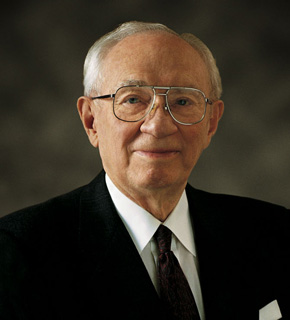
Gordon B. Hinckley (1910 – 2008)

Posted by bfwebster on January 27, 2008
Posted under LDS History, LDS Organization, Main, News, Succession

Gordon B. Hinckley

[For details on succession in LDS leadership, see this post.]

Gordon B. Hinckley, 15th President of the Church of Jesus Christ of Latter-day Saints (Mormon), passed away earlier today, at age 97.

No man ever came to office of LDS President more prepared than Pres. Hinckley. Long before he was called to the Quorum of the Twelve in 1961, he traveled the world for the LDS Church, helping to establish missionary efforts in countries where the Church had little presence. In 1981, he was called as a counselor to the First Presidency and within a short time found himself as the only fully functional member of that Presidency, as old age and illness limited the activity and capacity of both Pres. Spencer W. Kimball and 1st Counselor Marion G. Romney. He encountered a similar situation as a counselor to Pres. Ezra Taft Benson. Through both periods, he showed the greatest respect, restraint, and deference to the President of the Church. Finally, upon the death of President Howard W. Hunter, he became the 15th President of the LDS Church — and unleashed an era of change and worldwide expansion that had not been seen since the administration of Pres. Kimball 20 years earlier.

There are many things for which Pres. Hinckley will be remembered, including his quick wit, his frank talks at General Priesthood Meeting, and his amazing global travels over the past 50 years. But a century from now, I believe he will most be remembered for the incredible expansion of LDS temples worldwide. When he came into office in March of 1995, the LDS Church had just 47 temples in operation worldwide. Today, just 13 years later, there are over 124 temples in operation, with another 12 announced or under construction.

If you’ve read Pres. Hinckley’s biography, you know that during the years his family was growing and growing up, he would constantly remodel and expand their family home as required, doing all the work himself. However, in his later years, he and his (late) wife Marjorie moved into an apartment in downtown Salt Lake City next to the Church Office Building. While Sandra and I lived back in Washington DC, we got to know a sister in our ward, Marion Hardy, whose late husband had been missionary companies with Pres. Hinckley in England many decades earlier. She told me about visiting Pres. and Sister Hinckley in Salt Lake City a few years earlier. Pres. Hinckley (or “Gordie” as she called him) was showing her around the apartment when he led her over to a closet. Smiling, he opened the door — and there, neatly organized, were the myriad of tools that he had used over the decades to remodel their old house and perform his other construction and repair chores. He had little need or use for them, but he could not bear to leave them behind when he and his wife moved downtown.

Another true story, for I was there. Either 20 or 30 years ago, while I was at BYU — I honestly don’t remember if it was when I was an undergraduate or when I was teaching there — Pres. Hinckley came down from Salt Lake City to speak at the BYU multi-stake fireside held ever Fast Sunday evening in the Marriott Center on the BYU campus. When he got up to speak, he noted that he had encountered some reckless and inconsiderate drivers on the freeway on the way down to Provo. He said that it reminded him of a story he had once heard:

A Quaker farmer went out one morning to milk his cow. After he had been milking for a few minutes, the cow pulled up its hind leg and kicked the farmer, sending him sprawling. The Quaker quietly got up, brushed the straw off, and continued to milk. A few minutes later, the cow again jerked its hind leg and knocked the farmer off his stool. Again, the Quaker got up, brushed off straw and dirt, sat down, and continued to milk. A few minutes later, the cow let loose with both feet, knocking over not just the farmer but the almost-full bucket of milk, which emptied out all over the floor. The Quaker slowly got up, brushed himself off, and walked around to the front of the cow. He looked the cow in the face and said, “I cannot curse thee, and I cannot strike thee — but I can sell thee to the Methodist down the road who will beat hell out of thee.”

There was a collective gasp as 23,000 BYU students and faculty members took in the fact that an Apostle of the Lord had just said that in a Church fireside on a Sunday evening — and then a roar of laughter that lasted for quite some time.

I will miss President Hinckley, but I cannot grieve too much for his passing. He served the Lord and His Church unfailingly and with great effort and sacrifice for over 70 years, and I’m sure he has missed his wife Marjorie since her death back in 2004. He deserves the rest and the sweet company of his beloved wife. May the Lord bless his children, friends, and colleagues and help all of us to live up to his example and goals.

Our prayers and thoughts are also with Pres. Thomas S. Monson, who as the senior living Apostle, will serve as the 16th President of the Church of Jesus Christ of Latter-day Saints. ..bruce..

NOTE: Peggy Fletcher Stack (at the Salt Lake Tribune) has a well-written, detailed and thoughtful obituary for Pres. Hinckley.

NOTE: This appears to be the origin (or, at least, an earlier version) of the joke that Pres. Hinckley told at the fireside.

‘Cherubim and a flaming sword’ (a brief note)

Posted by bfwebster on January 25, 2008
Posted under Book of Mormon, Main

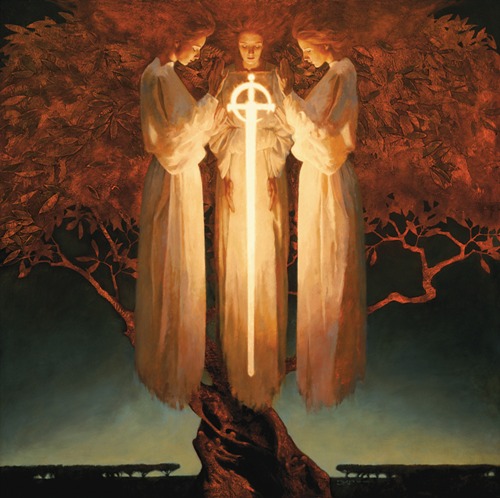
“Cherubim and a Flaming Sword” by J. Kirk Richards

So I drove out the man, and I placed at the east of the Garden of Eden, cherubim and a flaming sword, which turned every way to keep the way to the tree of life. (Moses 4:31; cf. Genesis 3:24)

Nephi’s vision of the Tree of Life (1 Nephi 11-15) contains imagery that ties into the description in Genesis/Moses of ‘a flaming sword…[keeping] the way to the tree of life’, but only after correcting for an apparent typographical error in the current editions of the Book of Mormon.

Royal Skousen, as part of his Book of Mormon critical text project, has reached the conclusion that 1 Nephi 12:18 in the original Book of Mormon manuscript (which still exists for that passage) says the following:

…and a great and terrible gulf divideth them yea even the sword of the justice of the eternal God…1 (emphasis added)

Note that this differs from our current edition of the Book of Mormon, which reads “word” instead of “sword”.2 This passage describes that which divides the wicked in the ‘great and spacious building’ from the Tree of Life, namely, ‘the sword of the justice of the eternal God’.

Nephi in later explaining Lehi’s (and his own) vision to his brothers Laman and Lemuel uses slightly different — but, in my opinion, related — imagery:

And I said unto them that it was an awful gulf, which separated the wicked from the tree of life, and also from the saints of God….And I said unto them that our father also saw that the justice of God did also divide the wicked from the righteous; and the brightness thereof was like unto the brightness of a flaming fire, which ascendeth up unto God forever and ever, and hath no end. (1 Nephi 15:28, 30; emphasis added)

Combining Nephi’s descriptions of his (and Lehi’s) vision of the Tree of Life, we have ‘the justice of God’ represented as both a sword and a flaming fire — combined, a flaming sword — and in both cases keeping the Tree of Life from those who choose the world (the ‘great and spacious building’) instead of coming to the Tree of Life on God’s terms.

In short, we have Genesis imagery in Nephi’s and Lehi’s vision of the Tree of Life. One could argue that there is temple imagery in there as well, since the structure of the Tabernacle and Solomon’s Temple has been interpreted as a reversal of the fall of Adam, with the candlestick (menorah) in the Holy Place representing the Tree of Life.3

What is perhaps more interesting is that we get through this vision an interpretation of the ‘flaming sword’ mentioned in Genesis — the justice of God, which prevents us in our willful state from approaching the Tree of Life. What the rest of Nephi’s vision tells us is that it is the love and condescension of God that gives us a path (‘strait and narrow’) and a guide (‘a rod of iron’)4 by which we can come and partake of the Tree of Life and thus enter back into God’s presence. ..bruce..

===================

1 Analysis of Textual Variants of the Book of Mormon: Part One (Title Page, Witness Statements, 1 Nephi 1 – 2 Nephi 10), Royal Skousen (FARMS/BYU, 2004), pp. 257-258.

2 On the other hand, see “The Word of God” by Leslie Taylor, Journal of Book of Mormon Studies, Vol. 12, No. 1 (2003), pp. 52-63, for an indication that the differences between ‘sword of God’ and ‘word of God’ as used in the scriptures may not be all that great.

3 See “Garden of Eden: Prototype Sanctuary” by Donald W. Parry, Temples of the Ancient World, edited by Donald W. Parry (Deseret Book/FARM, 1994), esp. p. 129 and pp. 134-135.

4 But see Skousen (above), pp. 174-181, who argues that this should be “straight and narrow”.

The missing blessing

Posted by bfwebster on January 24, 2008
Posted under Book of Mormon, Main

[NOTE: I originally wrote this essay back in 1994 for Vigor, an LDS samizdat put out for several years in the 90s by Orson Scott Card. Since we're studying the Book of Mormon in Sunday School this year, I thought it appropriate to repost it, with a few minor edits and with some links added in. It is reproduced here by permission.]

Where is Nephi’s blessing from Lehi? The first four chapters of 2 Nephi contain Lehi’s counsel, prophecy and blessings to the members of the group which he had led from Jerusalem to the Americas. These include remarks directed to his sons (Laman and Lemuel by implication, since he’s chastising them for their behavior up until then and pleading with them to repent); Laman, Lemuel, Sam and the sons of Ishmael; Zoram; Jacob; Joseph; the sons and daughters of Laman; the sons and daughters of Lemuel; the sons of Ishmael “and even all of his household” (it’s unclear whether that’s Ishmael’s household or Lehi’s, though context would indicate the former); and Sam again (with mention of his children). At this point, Nephi states that Lehi “had spoken unto all his household” (2 Nephi 4:12), but there is a very conspicuous absence: Nephi and his children.

It’s clear that Nephi was working from detailed sources, since he transcribed lengthy discourses by Lehi many years after the fact. And it is hard to believe that Lehi would bless and counsel every other son of his, both older and younger, as well as Zoram and the sons of Ishmael, and yet not have anything to say to Nephi. But there is no such blessing on Nephi’s small plates. Instead, Nephi follows all these other blessings with what is often known as “Nephi’s psalm”, lamenting his own weaknesses, his sins, his failings as he perceives them (2 Nephi 4:15-35). After this, he briefly chronicles his own flight (with followers) into the wilderness to escape his brethren and the subsequent history of his group, covering about 18 years in a few dozen verses. With that ends any of his own history-keeping on the small plates; the rest of 2 Nephi comprises discourses, prophecies, and quotations from Isaiah.

Nephi almost certainly had a record of the blessing(s) his father gave him; why did he omit them and instead write his soul-searching psalm? Several possible factors could account for it. Modesty is one, though Nephi has no trouble making himself the focus of the history he has recounted to that point, virtually all of which portrays him in a very good light. Avoiding duplication with the large plates is another — yet the other blessings were most likely copied from Lehi’s record on the large plates (1 Nephi 19:1-2; 2 Nephi 4:14); so if they were duplicated, then why not duplicate his own? A third could be the ultimate fate of his descendants: extinction at the hands of his brothers’ seed. Knowing that, why bother to copy the blessing, which would probably detail that yet again?

The key factor may well be pain and regret over his family’s division and his own possible role in it. Note where the lament is inserted: right between the account of Lehi’s death and his brothers getting angry with him and the account of his brothers threatening death and the subsequent family split. This is not to imply that Nephi had actually somehow failed, but that he felt all too keenly his shortcomings. Did he regretted his rather blunt and sometimes tactless chiding of his brothers and even his parents? Did he miss his brothers and all those who remained with them? Did he wondered if there was something he could have done differently that would have kept his family together? Anyone who has been through a divorce knows the pain and doubt that can linger years after the fact, even when it was for the best.

Nephi created the small plates some 30 years after he and his family left Jerusalem and some 15 years after the flight from his brothers. He crafted on them the story of his family, contrasting time and again his willingness to do the will of his father and the Lord with his brothers’ disobedience and rebellion. But when he got to his father’s last blessings and counsel, all that may have seemed like ashes in his mouth. His family was divided, his brothers still were seeking to destroy him and those he led, and he would be for the rest of his life a stranger in a strange land (cf. Jacob 7:26). Weary and heartsore, he probably looked at his own blessing, shook his head, and brought his history to a quick close, pausing only to express his pain and frustration with his own failings and to encourage himself to press on and trust in the Lord.

– Bruce F. Webster [Vigor, Issue 5, April 1994; note that up to and including that issue, Vigor published all articles anonymously. But I wrote this one; I'm sure I've still got the e-mail archives somewhere. :-) ]

Parallels: Catholic Mass and LDS endowment ceremony

Posted by bfwebster on January 18, 2008
Posted under Belief systems, LDS Doctrine, Temples, World Religions

Ben Huff over at Times and Seasons has an outstanding post drawing parallels between the LDS temple ceremony and the Catholic Mass (while also noting the key differences) in order to help those outside the LDS Church understand what goes on in the temple:

In a Catholic Mass, a congregation sits facing a priest, in a symbolic space, with an altar at the front, and participates in a standardized ceremony in which their spiritual relationships with one another and with God are symbolically represented and (re)affirmed. The priest leads the ceremony, with others assisting at various points. There are things the priest says, and responses by the congregation. The congregation stands and sits at various points, as part of this response, corresponding to whether they are praying or listening or reciting a creed or what have you. The Gospel is taught, and actively received. At the climax of the ceremony, each member of the congregation goes forward for a symbolic reunion with God, in this case represented by the priest and the Eucharist, in which God is said to be present.

The same basic format applies to the Mormon endowment. A congregation sits facing an officiator, in a symbolic space, with an altar at the front, and participates in a standardized ceremony in which their spiritual relationships with one another and with God are symbolically represented and (re)affirmed. The officiator leads the ceremony, with others assisting at various points. There are things the officiator says, and responses by the congregation. The congregation stands and sits at various points, as part of these responses. God’s plan of salvation is taught, and the teaching is actively received. At the climax of the ceremony, each member of the congregation goes forward for a symbolic reunion with God, in this case represented by entry into the Celestial Room, representing the presence of God.

Be sure to read not just the whole post, but also the comments, which are not only thoughtful but contain some links to additional analysis.

[UPDATED 01/25/08 - 1512 MST] You might also want to read this article (“Knocking Three Times on the Holy Door“) over at the excellent Temple Study blog. ..bruce..

A smart move by Obama

Posted by bfwebster on January 18, 2008
Posted under Main, Politics

[UPDATED 02/04/08 -- Here is an LDS Church press release about Michelle Obama visiting LDS Church headquarters today and spending time with Apostles Russell Ballard and Quentin Cook. Hat tip to A Soft Answer.]

[UPDATED 01/31/08 -- I've been getting some hits from people using search engines to see if Barack Obama is a Mormon. Answer: no, though we'd love to have him. Obama is a member of the Trinity Unity Church of Christ, though he has publicly distanced himself from a few of the actions and comments of its retiring senior pastor, Rev. Dr. Jeremiah A. Wright, Jr.]

According to the Beehive Standard Weekly — an LDS news source that I encountered for the first time today — the Barack Obama campaign staff is looking to reach out to moderate Latter-day Saints for the general election should McCain and/or Huckabee end up as the Republican candidate:

An important source at the highest levels of the Obama Campaign in Nevada said Thursday that the Obama Campaign is most fearful of Mitt Romney coming out as the Republican candidate as he is dynamic and has a command of economic issues. This revelation came about as the Obama Campaign was inquiring to several Mormon civic leaders about a possible Mormon cross-over vote in the Southwest to Obama if Huckabee or McCain were to be the eventual nominee. The reliable source indicated that the Obama camp is currently implementing a plan to attract Mormon Moderate Republicans to their camp as a second choice to Romney, assuming he doesn’t get the Republican nomination.

If true, this is a smart move for several reasons. First, both the Huckabee and, to a lesser extent, the McCain campaigns have already been involved in attacking or slurring the LDS faith in an effort to counter Romney. From what I can see, there are many Latter-day Saints right now who would frankly refuse to vote for either McCain or (especially) Huckabee for exactly that reason. Most US-based Latter-day Saints have dealt with a lifetime of active anti-Mormon literature and protests from the Religious Right and are largely disgusted thereby.

Second, I suspect that moderate and even liberal Latter-day Saints would be more prone to support Obama rather than Clinton due to the moral baggage that the Clintons would bring back to the White House.

Third, I suspect that many Latter-day Saints would respond to a sincere outreach effort by Obama due to the constant (and, in my opinion, largely erroneous) labeling of Latter-day Saints as racist due to the former policy regarding blacks and the priesthood. It’s interesting to note that Armand Mauss’s sociological research regarding Latter-day Saints’ attitude towards blacks in the late 1960s showed no significant difference with those evinced by white American Protestants or Catholics.1 And as has been well-documented elsewhere, the overwhelming reaction of the LDS Church membership when the policy changed in 1978 was relief and gratitude.

Fourth, while the common caricature of Mormons is as rock-ribbed Republicans, that overlooks the fact that what was the single greatest concentration of Mormons in the world — the population of the state of Utah — kept electing and re-electing Democratic governors for decades. From 1917 until 1985, the governor of Utah was a Democrat for 50 of those 68 years, including a 20-year block from 1965 until 1985. In fact, the single longest-serving Governor (Territorial or State) of Utah, and one of the most popular, was a Democrat: Calvin “Cal” Rampton (1965-1977). Likewise during that same period (1917-1985) at least one of Utah’s US Senators was a Democrat for 52 of those 68 years. Note that this all occurred during a period when Mormons made up a higher percentage of the population of Utah than they did today.

The shift of Mormons away from the Democratic Party over the past 20+ years is, I suspect, due largely to the ‘radicalization’ of the Democratic Party during that time. However, the rise of the Religious Right as a major power base within the Republican Party, particularly with Huckabee’s candidacy, leaves many Mormons uneasy due to the pervasiveness of anti-Mormon literature and attitudes among Evangelical Christians. If the Presidential contest this fall is between a Democratic ticket starring Obama and a Republican ticket with Huckabee and/or McCain, Obama could well be very successful in getting a significant portion of the LDS vote in the Western US. ..bruce..

=======================

1 See Mauss, Armand L. All Abraham’s Children: Changing Mormon Conceptions of Race and Lineage (University of Illinois Press, 2003), esp. Chapters 8 and 9.

Why the divide?

Posted by bfwebster on January 14, 2008
Posted under Belief systems, LDS Doctrine, LDS History, LDS Society, World Religions

Morehead’s Musings has an extended interview with Armand Mauss, an LDS sociologist who has done extensive research and writing on sociological aspects of the LDS Church. Mauss concisely states my core question about the Evangelical rejection of the LDS Church as ‘Christian’:

I recognize that there are some serious theological issues that make Mormons seem especially scary to many Evangelicals. In one way or another, most of those issues seem to shake down to doctrines of deity. Mormonism will never be able to accommodate the traditional Trinitarian theology, and that theology, in turn, seems to be the “litmus test” of “true” Christianity for Evangelicals. When Mormons, in all sincerity, claim to believe in the divinity of Jesus, and in His indispensible salvific role in human history, Evangelicals tend to dismiss such claims because they are not made within the context of Trinitarian theology. There is some irony in this Evangelical dismissal of the “Mormon Jesus,” since many surveys in recent decades have shown that many, if not most, of the modern clergy of the “Protestant mainline” do not believe in the literal divinity of Jesus or in His literal resurrection. Yet no one would claim that these denominations –- or even their clergy — are “not Christians.” Evangelicals also object to Mormon doctrines about the role of Jesus in the pre-existence, and/or the Mormon conception of God as once mortal – even though such ideas are strictly theoretical and play no part whatever in modern Mormon worship, or in the de facto Mormon focus exclusively on the God of Abraham as the only God ever encountered in Mormon scriptures and discourse. For some reason, these theoretical Mormon “embellishments” on doctrines about deity disqualify them from the “Christian” label, but Roman Catholics are not disqualified by the elaborate cult of Mary, or by such doctrines as the immaculate conception or transubstantiation, none of which are strictly biblical. It seems that for mainline Catholics and Protestants, all extra-biblical ideas are forgivable as long as they embrace a Trinitarian deity, but Mormons can’t be permitted their extra-biblical ideas and still be part of the Christian “family.”

I am no theologian, and I must confess that I find theological disputes generally tedious; as a social scientist, my main interest in theology is pretty much limited to its implications for behavior. I guess that’s why I find it difficult to understand why the “divide” has to be so “wide” between Mormons and Evangelicals.

Read the whole thing. ..bruce w..

Mitt Romney’s new ward? [UPDATED]

Posted by bfwebster on January 12, 2008
Posted under Humor, LDS Society, Main, Politics

[UPDATE 01/14/07] A reader kindly pointed out to me that if you go to the “Worship With Us” section on Mormon.org and type in the White House address, it shows that Romney would attend DC 3rd Ward (there have obviously been some changes since I left DC back in 2005). I’ve updated some of my comments below appropriately.

====================================

I belong to an “LDS/National Security” e-mail list (and the fact that such a listserv exits should give this author some pause for thought). Most discussions are serious, but some occasional humorous bits come through. I found this one particularly funny since I lived for six years in the ward (Chevy Chase Ward, Washington DC Stake) that Mitt Romney and his family might well attend were he elected, including a few years in the bishopric (congregational leadeship) of that ward. I’ve stuck in a few notes based on my experience there. ..bruce..
============================

Mitt Romney’s new ward?

So….if Mitt Romney became President of the US (from this point forward referred to as POTUS), won’t we have something we’ve never had before – a president who goes to a specific church? All other presidents belonged to religions that didn’t have tight congregational boundaries. Now, think about that: What Ward would POTUS be in? [See above.] If you are his new Bishop, here are your top 10 questions:

1. Will you allow an inaugural ball to be held in the cultural hall? Do you mount security cameras on top of each basketball rim and have a secret service detail stationed on the stage?

2. Can you call Mitt and Ann as the Nursery leaders… even if you really feel inspired?

3. Who is going to home teach them? Will you call someone who needs activation but may not pass the vetting and national security screening?

4. If Harry Reid [who is in the Chevy Chase Ward] and Mitt Romney are in the same High Priest group, will you need to be there to keep order?

5. Exactly how will tithing settlement work? Will the Secretary of the Treasury come, too?

6. Will you be inviting the new Romney family to speak in Sacrament Meeting… and if they go a little over, at what point do you ask them to sit down?

7. Will the Secret Service do a sweep of the building before each meeting? And if the Romney’s always leave before Sunday School, will the Sunday School president need to interview them? If they stay, where will you hold the class?

8. Can you call the Secret Service agents to help out in Primary?

9. If you give Mitt a calling and the two Democrats in the Ward [NOTE: there's a lot more than just two Democrats in any of the DC wards and branches] raise their hand AGAINST sustaining him – partly out of habit – does the Supreme Court need to be involved?

10. If you can’t give them a calling (job), and they don’t attend very often (for presidential stuff), will that mean they’re ‘inactive?’ If they’re not active, can you give them a Temple Recommend? And if you do, can they go? Will the Secret Service have to screen the temple too?

11. If the President wants to hold Sacrament Meeting at Camp David or the White House for security reasons, is that a conflict of Church and State?

If you’re assigned to be the Romney’s home teacher:

1. Can you just drop by, no appointment?

2. Can you even call them for an appointment, or do you have to go through the Chief of Staff?

3. Can you bring by Christmas sweets and cookies? Will they be analyzed? And for how many people – family, secret service details?

4. If you don’t come, can the IRS do an audit on you?

5. Will they want to do a national security background check?

6. Do you have to have a permanent companion who has been vetted? Can you just grab any teacher or priest to come with you? And what if that priest has been a little wayward? Do you need to search him first?

7. Do you have to help him move in and out of the White House?

8. If Ann Romney gets sick, are you allowed to bring in meals or at least tell the Relief Society about it?

9. What can you share with the Bishop about the Romneys?

10. Do you have to ask them about their year’s supply?

11. If you get a late night call for a blessing, will reporters follow you around wanting to know what was wrong and what you said?

If Mitt Romney is assigned to be YOUR home teacher,

1. Is telling the group leader you haven’t been home taught a national security breech?

2. If he wants to come at the end of the month, do you accept his reason, ‘I’ve been out of town’?

3. Will he drop by unannounced, or will the media crews give him away?

============================

Heh. The good news is that if Romney were to attend the Chevy Chase Ward, the Washington DC Stake would probably finally buy the property next door to the Chevy Chase Ward building and put in some decent parking — which the Chevy Chase residents in that neighborhood would probably be very grateful for, given all the street parking that gets taken up every Sunday. ..bruce..
Switch to Day Switch to Night