I’m in Chicago for a patent trial (I’m an expert witness) and will tied up for another week or so. ..bruce..
Monthly Archives: September 2007
The parameters of reality (ours, at least)
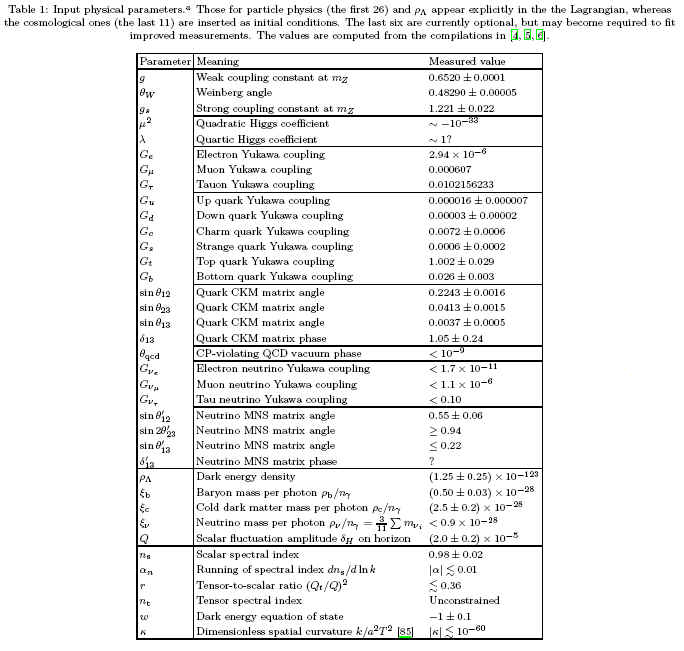
One of the intriguing aspects of reality, as far as we are able to analyze and perceive it to date, is that it depends upon a relatively small set of dimensionless parameters. Here is a listed set, taken from the paper “Dimensionless constants, cosmology, and other dark matters” by Max Tegmark (MIT), Anthony Aguirre (UCSC), Martin J Rees (Cambridge), and Frank Wilczek (MIT) (Phys.Rev. D73 (2006) 023505):
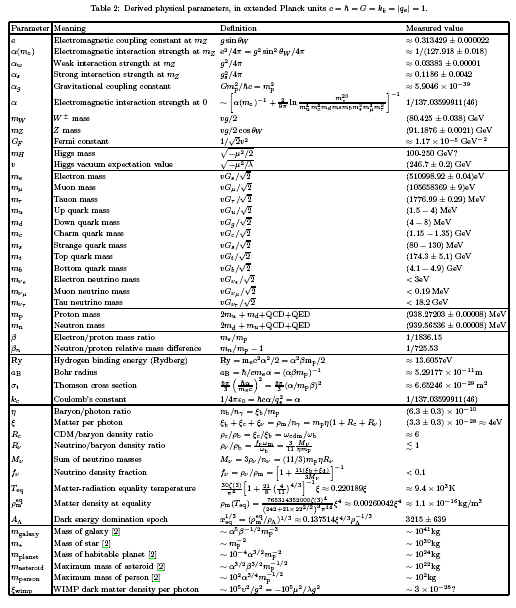
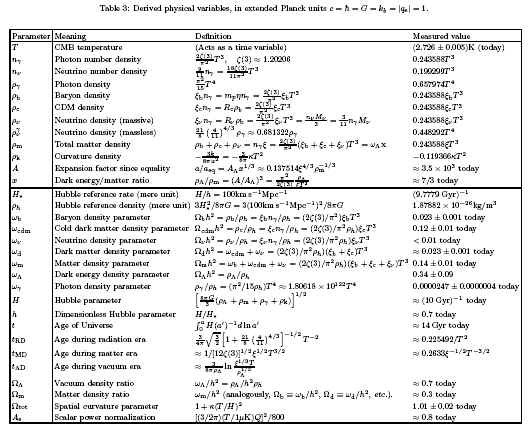
And here are the derived physical parameters:
I got to this paper via an article in New Scientist (subscription required for full article) by one of the paper’s authors (Max Tegmark) who feels that our universe itself is a mathematical construct:
Here, I will push this idea to its extreme and argue that our universe is not just described by mathematics – it is mathematics. While this hypothesis might sound rather far-fetched, it makes startling predictions about the structure of the universe that could be testable by observations. It should also be useful in narrowing down what an ultimate theory of everything could look like….
So here is the crux of my argument. If you believe in an external reality independent of humans, then you must also believe in what I call the mathematical universe hypothesis: that our physical reality is a mathematical structure. In other words, we all live in a gigantic mathematical object – one that is more elaborate than a dodecahedron, and probably also more complex than objects with intimidating names like Calabi-Yau manifolds, tensor bundles and Hilbert spaces, which appear in today’s most advanced theories. Everything in our world is purely mathematical – including you.
Tegmark also feels that this hypothesis leads inevitably to the conclusion that multiverses exist that embody different combinations of dimensionless parameters; we just happen to be in one in which life as we know it can evolve. I’m impressed that Tegmark et al. in the “Dimensionless parameters” paper were willing to include “design” as one explanation for the “fine-tuned for life” values of the parameters, though (rightly) stating that physicists prefer the others:
So why do we observer these 31 parameters to have the particular values listed in Table 1? Interest in that question has grown the the gradual realization that some of these parameters appear fine-tuned for life, in the sense that small relative changes to their values would result in dramatic qualitative changes that could preclude intelligent life, and hence the very possibility of reflective observation. As discussed extensively elsewhere [list of footnotes], there are four common responses to this realization:
- Fluke: Any apparent fine-tuning is a fluke and is best ignored.
- Multiverse: These parameters vary across an ensemble of physically realized and (for all practical purposes) parallel universes, and we find ourselves in one where life is possible.
- Design: Our universe is somehow created or simulated with parameters chose to allow life.
- Fecundity: There is no fine-tuning, because intelligent life of some form will emerge under extremely varied circumstances.
Options 1, 2 and 4 tend to be preferred by physicists, with recent developments in inflation and high-energy theory given new popularity to option 2. (Tegmark et al., Phys.Rev. D73 (2006) 023505, pp. 1-4)
No great theological or philosophic intent to this posting, other than I tend to lean towards the “Design” answer. My intended college major during my senior year of high school was astrophysics; that came to a halt upon reading an article about the bartenders and cab drivers with PhDs in astrophysics, but I remain interested in the topic. On the other hand, as someone who has done real-world simulation work (cruise missiles, large space structures, the Space Shuttle flight simulators, and tectonic processes on Venus), I’m keenly aware of how model definition and parameter selection directly leads to your results. ..bruce..
Rethinking the Flood from an LDS perspective
[UPDATED 01/24/11 — 1857 MST] Found out that most links in the article pointed at the Web Archives versions of the links (as part of my restoration 18 months ago); have updated them all (I believe). Also note that the Younger Dryan impact theory has not found a lot of acceptance due to evidence issues.
[UPDATED 08/31/09 — 1850 MDT] Somehow, the text of this post vanished, probably during one of my efforts to save and restore the entire website due to security issues. I found this text at the Internet Wayback Machine and have restored it.]
[UPDATED 11/11/07 – 1804 MST] Added the actual Hugh Nibley quote below, which I moved to the start of the posting, and made a few additional edits for clarification and to reflect some of the information presented at the Younger Dryas Impact press conference.
[UPDATED 11/01/07 – 1027 MDT] Here is a link to YouTube videos of the Younger Dryas Impact AGU Press Conference. Based on what’s presented here, it would suggest (contra some of my initial speculation below) that the ‘Flood party’ left before the impact, given the scientists’ postulation of a large firestorm on the North American continent. More as I work through the videos. ..bfw..
The stories of the garden of Eden and the Flood have always furnished unbelievers with their best ammunition against believers, because they are the easiest to visualize, popularize, and satirize of any Bible accounts. Everyone has seen a garden and been caught in a pouring rain. It requires no effort of imagination for a six-year-old to cover concise and straightforward Sunday-school recitals into the vivid images that will stay with him the rest of his life. These stories retain the form of the nursery tales they assume in the imaginations of small children, to be defended by grownups who refuse to distinguish between childlike faith and thinking as a child when it is time to “put away childish things.” (1 Corinthians 13:11)
– Hugh Nibley, “Before Adam”, talk given to BYU students in 1980, reprinted in Old Testament and Related Studies — The Collected Works of Hugh Nibley: Volume 1 (Deseret Book/FARMS, 1986), p. 63.
This article in Dialogue by Clayton White and Mark Thomas addresses in an LDS setting what numerous other articles and postings have in more generic Christian and Jewish settings: the inconsistencies between classic Christian/Jewish interpretations of the Genesis Flood story and, well, pretty much every bit of geological, archaeological, and biological evidence we have for the time period in question (typically set around 2350 BCE). White and Thomas address the problems just from a biological point of view, but their endnotes indicate some of the other problems as well.
I have no real problems with the idea that a global flood could occur — in my opinion, a God Who created, perceives and runs the entire universe could probably come up with some easy (for Him) mechanism to schlep the required 1.4 billion cubic miles or so of H2O onto the earth and then drain it off again. Indeed, such a task would be no more difficult for Him than rinsing and mopping a floor is for us (and probably a lot easier). But, as many folks have pointed out, most recently White and Thomas, such an event would leave, well, catastrophic evidences worldwide.
Every single civilization in existence at that time — indeed, the population of every single city, town, and village — would cease to exist, leaving behind water-logged ruins. Repopulation would occur, but it would be from a relatively small source and a single location, and it should follow some reasonable population and cultural diffusion model. White and Thomas detail all the biological impacts, which are profound and global. (Those who defend the Genesis Flood story are usually those who argue against any form of evolution — yet as White and Thomas point out, they would have to posit a hyper-evolutionary mechanism to explain the extreme diversity of species, post-Flood.) Geological evidence would abound as well. Yet there is no evidence in any of these areas — archaeological, biological (including DNA), or geological — for the classic Flood. Quite the contrary: all such evidence, and there is plenty, points to no such Flood happening in the presumed timeframe.
There are four typical responses to this dilemma:
- All the evidence (or lack thereof) is wrong
- God wiped away all evidence of the Flood — which strikes me as sort of defeating the whole purpose, and which also requires so many other special acts (hyperevolution, instant repopulation of destroyed civilizations, etc.) as to run afoul of Occam’s Razor
- The Flood was actually a localized event (such as the flooding of the Black Sea — though many dispute the suitability of this particular event)
- The Flood is just a myth
My own opinion is that we’re caught in a double trap: justifying the details of the Flood as recorded in Genesis and adopting the ‘4004 BC’ chronology likewise derived from Genesis. The root cause of that dilemma is that early LDS Church leaders accepted the ‘4004 BC’ chronology without realizing they had already refuted it. Joseph Smith famously said that the Book of Mormon was “the most correct of any book on Earth and the keystone of our religion.” And what does the Book of Mormon have to say on the chronology of the human race? Just one thing:
Yea, and behold I say unto you, that Abraham not only knew of these things, but there were many before the days of Abraham who were called by the order of God; yea, even after the order of his Son; and this that it should be shown unto the people, a great many thousand years before his coming, that even redemption should come unto them. (Helaman 8:18; emphasis mine)
The setting of this comment by the prophet Nephi2 (son of Helaman) is just a few decades before the birth of Christ. And he states that God had revealed the coming of Christ and established the priesthood “a great many thousand years” before Christ’s coming. Any way I look at that phrase, it appears to be a lot more than just four (4) thousand years before Christ’s coming.
(To be fair, there is always the chance that “a great many thousand” was a peculiar language idiom where “a great many” was an intensifier rather than a count value. But I know of no basis for that assumption, since the Book of Mormon authors have no problems at all counting many thousands of people, and all other Book of Mormon uses of the phrase “a great many” appear to indicate just that: a great many.)
And if you interpret “a great many” to be at least greater than twelve (12), that pushes us back into the last glaciation period — during which, throughout much of the world, “water” (ice) covered the tops of the mountains and at the end of which great floods occurred due to breaking ice dams and glacial melting.
Most notably, it appears that at least one massive flood occurred about 13,400 years ago on this (the American) continent — where LDS doctrine places the antediluvian patriarchs — when on-going warming caused the release of a massive body of water into the North Atlantic oceaqn — which in turn may have triggered the last cold period (the Younger Dryas), with the corresponding climate change and rapid glaciation. There are indications that another major flood occurred during the last ice age but into the North Pacific ocean instead.
On the other hand, there is also speculation (with significant and widespread geological evidence) that an extraterrestrial impact may have triggered the Younger Dryas and a massive (North American) extinction, with a Tunguska-like airburst occurring over the North American glacial sheet:
The associated blast wave and thermal pulse would have contributed to the megafaunal extinctions and destabilized the Laurentide Ice Sheet, loading the atmosphere with dust, soot, NOx, and water vapor and triggered the YD cooling. (from the abstract for Evidence for a Massive Extraterrestrial Airburst over North America 12.9 ka Ago; emphasis mine)
So what we have in North America is a period of warming, accompanied by a period of floods. That is intensified by a firestorm resulting from a possible extraterrestrial impact, which in turn is followed by the Younger Dryas rapid cooling period — with increased rain, snow and glaciation around most of the world (though an overall drying trend as water gets locked up into ice) — quite literally with water (albeit frozen) covering the tops of the mountains. All of this leads to massive fauna and flora extinction, including possible “widespread, abrupt human mortality” at least on the North American continent and possibly on a global basis.
The Flood, as recorded in Genesis, could then represent a local record of a catastrophic event with global impact. Noah, being warned (much as Lehi), would have started off from North America ahead of the impact and — reversing the travels of Jared and Lehi — carried his family, along with sufficient livestock for their travel purposes, across the ocean (most likely the Atlantic) to somewhere in and around the Mediterranean. During that transit, Noah and his family spend months crossing the ocean — which would have left them with the impression that the entire earth had been covered with water. Wherever they landed in the Old World may have been deserted and depopulated (due to the ice ages) when they arrived, adding to the impression of all human life being wiped out. In any case, the Middle Eastern climate may well have been the best place to weather the Younger Dryas cold period (~1200 years) and may indeed have been quite temperate and lush in contrast to the hot, dry climate that exists today.
Food for thought. ..bruce..
P.S. Just so everyone’s clear, I wrote the original post in one sitting, so I reserve the right to continue to edit and revise it as things occur to me or I run across items that support or modify my thesis.
Lest we forget


Gerard Vanderleun — who was just across the river from Manhattan, in Brooklyn Heights, when the WTC was hit — has posted his own memories of that day:
I’ll simply link to my posts from last year, as well as Bruce Henderson’s:
- In Memoriam: Robert David Peraza
- Remembering the WTC
- We Will Never Forget (Bruce Henderson)
This was an act of war — a simultaneous attack on our financial, military and political centers that cost thousands of lives and billions of dollars. Pity we have lost sight of that:

..bruce..
The last of “September Dawn”
My last posting on this subject, since “September Dawn” has died a well-deserved death. Here are the figures for its third weekend in release: a grand total of $7,445 in all of 26 theaters, a 96% drop from last weekend. To give you some perspective, the #1 film this past weekend — also a Western, “3:10 to Yuma” — grossed an average of $5,292 in each and every one of the 2,652 theaters in which it played, for a total of $14+ million.
Having no desire to either support the producers of this film or subject myself to what Justin Chang in Variety (undoubtedly another crypto-Mormon) called “massacre porn“, I cannot directly opine on the merits of the film. But based on the reviews I’ve read, I think it’s not only clear that “September Dawn” is generally a wretched movie and historically distorted, it’s also unabashedly anti-Mormon. It’s a shame, because I think that a very thoughtful and provocative movie could have been made.
Next up, I’m waiting for a film version of “The Protocols of the Elders of Zion.” Oh, wait — someone’s already doing that. ..bruce..
Someone who gets it
As I’ve mentioned before, one of my sources of both frustration and amusement during my 40 years as a Latter-day Saint has been the sheer number of people who either misunderstand or deliberately misrepresent LDS history, beliefs and practices. So it is always a delight to run across a well-written article by someone outside the LDS Church who not only under understands LDS culture and doctrine, but who provides new insights.
Such an article is “A Mormon President? The LDS Difference“, written by Laurie Maffly-Kipp and published in The Christian Century. Maffly-Kipp is Associate Professor of Religious Studies at the University of North Carolina (Chapel Hill), and one of her areas of specialty is Mormonism. She clearly has done her homework; I’ve never seen someone outside the LDS Church (or few within it) so clearly articulate the balance of authority and independence within the Church:
Yes, the prophet can receive revelation. But this power is couched within a set of concentric circles of revelation and authority: the prophet receives revelation for the church, bishops receive revelation pertaining to their wards (local churches), and fathers and mothers receive revelation relating to their families. Most important, Mormons—like Protestants—attach great importance to the agency of the individual believer, who is expected to pray and receive guidance for herself. This set of interconnected responsibilities makes for clear lines of authority, to be sure—few agencies are as efficient as a local Mormon ward in action—but it also means that leaders cannot, in theory, overstep the bounds of the authority bestowed on them by virtue of their office.
In practice, then, LDS religious authority is diffused and regulated in quite orderly ways; indeed, one might say that this flow is both more controlled than in many Protestant churches and more democratically distributed than in Roman Catholicism. Mormons are taught from a very young age that their purpose in life is to exercise their own spiritual agency and to maintain a right relationship with God. The church hierarchy, of course, has a major role in facilitating that growth, but not the only role. Higher education is valued for both men and women, regardless of one’s career path. Healthy living and moral values are extolled not simply as exercises in discipline, but as keys to individual progress. Considerable emphasis, in other words, is placed on the individual cultivation of personal agency, a fact that may help explain the resounding business success of someone like Mitt Romney.
Nor do LDS Church members in good standing bow to church officials at every point; the authority of many church teachings is, in fact, somewhat ambiguous. There are a number of incontrovertible teachings, of course (such as: Joseph Smith was a prophet; sex before marriage is forbidden), but these are surprisingly few in number. Many other decisions are left to the dictates of individual conscience. One need only ask 10 church members about whether Mormons are allowed to drink caffeinated soft drinks to encounter a wide range of interpretations.
I strongly recommend the article, and I plan to keep a look out for other articles and books by Maffly-Kipp. ..bruce..
“We are as the army of…Master Chief?”
Sandra and I had two of our grandsons spend the weekend, Ashton (8) and Raiden (5). When Sandra drove them back home (Longmont, just outside of Boulder), she spent a few minutes speaking with their mom, our oldest daughter, Chase. Sandra had noticed Ashton teasing Raiden a bit about the video game Halo during the drive back up; Chase confirmed that Raiden really, really likes Halo. Chase said she didn’t realize quite how much so until Raiden’s Primary teacher (Primary ~= Sunday School for kids 3-11) told her that Raiden tends to relate all of the class lessons to Halo. (The Primary teacher said that her husband plays Halo as well, so she generally knows what Raiden is talking about.)
Somehow fitting for a kid who was, yes, named after a character from Mortal Combat. ..bruce..
(ObExp for non-LDS: the title refers to a well-known Primary song, “We’ll Bring the World His Truth“, better known by the first line of its chorus: “We are as the army of Helaman” — a song that never fails to move me to tears when sung by a group of children and which allows me to excuse Janice Kapp Perry for the rest of her rather ah, bland oeuvre.)