Adventures in Mormonism

Correcting the incorrigible

Archive for September, 2009

Why you should have beer in your food storage

Posted by bfwebster on September 23, 2009
Posted under Main, Preparedness, The Last Days

Popular Mechanics — which has done a wonderful job of reinventing itself for the Web — has an article on five unusual survival checklist staples. While I’ve been touting contractor bags for over a decade (PDF file), and books are a given for me (including in 72 hour kits), it’s the first item on the list that’s interesting:

1. Beer

“Buy a lot of it,” says Trey Click, a magazine publisher who rode out last year’s Hurricane Ike in Galveston, Texas. “It’s one of the only things you can use for money in the aftermath.” Need your neighbor to help you clear trees out of your yard? A case of Bud is a better motivator than a $20 bill when all the stores are boarded up.

I doubt that most of us would stock beer in our emergency preparedness supplies, particularly those who still have teenagers at home (it’s just asking for trouble), not to mention the actual ethical dilemma of handing out beer to our neighbors. Still, the issue that Click brings up is a good one: what can you barter with in the aftermath of a major disaster when money isn’t of much immediate value? I’m not sure canned soda (particularly if there’s no power) has quite the same caché. Maybe those large boxes of candy bars you get at Costco? Thoughts?

Here’s my own contribution to “unusual survival staples”: make sure that many of your critical battery-operated devices use C cell batteries. Sandra and I were living four miles from the epicenter, on the Santa Cruz side of the mountains, when the 1989 Loma Prieta earthquake hit and so were in the thick of things; also, the main highway (Hwy 17) from San Jose was closed for six weeks due to landslides. Within 24 hours or so, all the local stores were completely out of AAA, AA, and D cell batteries, but they had piles of C cell batteries (in the case of the Soquel Safeway store, it was literally a pile on the floor, and quite a large one).  ..bruce..

The Second Quorum of the Twelve

Posted by bfwebster on September 8, 2009
Posted under Book of Mormon, Church administration, LDS Doctrine, LDS History, LDS Organization, Main

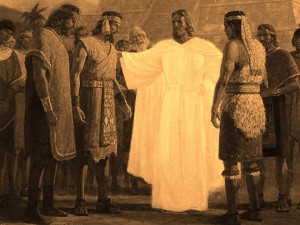
The Nephite Apostles

[Note: this is a follow-up to the discussion in the comments to this post some months back.]

We believe in the same organization that existed in the Primitive Church . . . .
– 6th Article of Faith

Yea, behold, I write unto all the ends of the earth; yea, unto you, twelve tribes of Israel, who shall be judged according to your works by the twelve whom Jesus chose to be his disciples in the land of Jerusalem. And I write also unto the remnant of this people, who shall also be judged by the twelve whom Jesus chose in this land; and they shall be judged by the other twelve whom Jesus chose in the land of Jerusalem.
– Mormon 3:18-19

“[The Book of Mormon] tells us that our Savior made His appearance upon this continent after His resurrection; that He planted the Gospel here in all its fulness, and richness, and power, and blessing; that they had Apostles, Prophets, Pastors, Teachers, and Evangelists, the same order, the same priesthood, the same ordinances, gifts, powers, and blessings, as were enjoyed on the eastern continent . . . ”
– Joseph Smith (from the Wentworth Letter, 1842; cf. History of the Church 4:538).

Back during the ‘Primitive Church’ era, it appears that there were 24 apostles on the earth, organized into two separate quorums: the Twelve in the Old World (led by Peter) and the Twelve in the New World (led by Nephi3). While it is true that the New World Twelve were never specifically called apostles within the Book of Mormon, Joseph Smith referred to them as such, and Joseph Fielding Smith cautiously agreed.

Mormon’s comments, cited above, indicate that the New World Twelve were subordinate to the Old World Twelve. In modern-day LDS parlance, we could refer to the Old World Apostles as the First Quorum of the Twelve, and to the New World Apostles as the Second Quorum of the Twelve.

Nowadays, however, we only have the (one) Quorum of the Twelve. Given the 6th Article of Faith, the question comes up: what are the chances of the Church setting up a Second Quorum of the Twelve, as existed in the Primitive Church? And if the Church did so, how would it work, particularly given the tradition of succession in the modern Church?

First, let’s see why the Church might organize the Second Quorum of the Twelve.

When I joined the Church in 1967, Church membership was around 2.6 million, with about 450 stakes and 4,200 wards and branches. The large majority of that membership was in the Western United States, Western Canada, and northeastern Mexico. Apostles and even First Presidency members would visit stake conferences on a regular basis; I got to shake hands with Pres. Hugh B. Brown and Elder LeGrand Richards as a teenager that way. Back then, each bishop was set apart by an Apostle.

Today, Church membership is approaching 14 million, with 2,800 stakes and nearly 25,000 wards and branches (roughly a 5x growth in all three categories). Over half of the Church membership lives outside of the United States. And we still have just twelve Apostles.

The gap has been filled by the Presidents and Quorums of the Seventy (not to mention stake presidents). They really are the eyes and ears and legs and hands of the Apostles throughout the world. But the collective Seventy still have to feed into just twelve Apostles. I suspect that the members of the Quorum of the Twelve carry tremendous administrative, spiritual, and ministering burdens — and yet in all that, it is the core of their calling to be special witnesses of Christ.

Imagine, then, how that burden would be lifted if there were a Second Quorum of the Twelve, another set of 12 Apostles among whom to share the load at that level of Church administration.

How might this work?

Let’s follow the model in the meridian of time and assume that the Second Quorum of the Twelve is subordinate to the First Quorum of the Twelve. Seniority in the Second Quorum would work just like, but be independent of, the seniority in the First Quorum. There would be no automatic succession from the Second Quorum to the First; instead Apostles in the Second Quorum would be put on emeritus status when they reached 70 years of age. However, the Second Quorum would provide a fertile ground for candidates to fill vacancies in the First Quorum upon the death of an Apostle.

In other words, it would work pretty much just like the Presidency of the Seventy works right now. In fact, I could argue that the Presidency of the Seventy fills the function of the Second Quorum of the Twelve, except that there’s only seven of them and they don’t have Apostolic authority.

Now, what if that were to change? What if the Church dissolved the Presidency of the Seventy, organized the Second Quorum of the Twelve, and then organized the 9th, 10th, 11th, and 12th Quorums of the Seventy, with an Apostle over each Quorum? Church government and organization is flexible as the times require; I was once a Seventy myself, and was even a President of Seventy (it was a stake position some 25 years ago — there were seven Presidents of Seventy in each stake). So it wouldn’t bother me in the least if the Church were to do this kind of reorganization. (I will admit being startled for a second when the Church organized the Eighth Quorum of the Seventy, though I believe a close reading of D&C 107:95-96 allows that interpretation.)

As an alternative approach, what if the Church left the Presidency and Quorums of the Seventy just as they are now, but called an entirely new Second Quorum of the Twelve? This second Quorum could truly act as a “traveling presiding high council” throughout the Church, going as a quorum, in pairs, or individually to various parts of the world to help strengthen the church. In fact much like Elders Oaks and Holland, members of the Second Quorum could live outside of the United States on a permanent or near-permanent basis, providing resident Apostolic authority throughout the world, while traveling back to Salt Lake on a regular basis to meet with the First Presidency and the First Quorum of the Twelve (though I suspect the Church would use two-way, satellite-based videoconferencing to reduce actual travel).

Given this second approach, I suspect that the Second Quorum would largely comprise Apostles whose native language is something other than English and/or whose native country is outside of the United States and Canada.

This approach would allow Church members throughout the world to hear in person from Apostles speaking their native tongues on a regular basis. At the same time, these worldwide Apostles could work more actively and directly with the governments of the countries over which they preside to help see to the Church’s interests in those countries.

This approach would, I believe, tremendously strengthen the Church worldwide, especially in those areas (Latin America, Africa, the Philippines) where Church growth frequently outstrips the leadership pool. And for those keeping an eye on the Last Days, it would also ensure Apostolic authority distributed throughout the world in the event of major war and/or natural catastrophes.

Any thoughts?  ..bruce..

A great GayPatriot brunch

Posted by bfwebster on September 5, 2009
Posted under Current events, Food, Main, Politics

Sandra and I attended a brunch today, hosted by Dan Blatt of GayPatriot.net here in downtown Denver. There were eleven of us in all there, and the discussions were all quite interesting. Dan’s a screenwriter in west LA; at one point, he said that the tricky part of living there is not indicating that he’s gay but rather that he’s a conservative, though he says now he does it just to enjoy the reaction (and to get a sense of what kind of person he’s talking with).

If you’re not reading GayPatriot, you should be; it’s in my Blogs Level One bookmarks folder (read at least once/day and often twice/day).

So, what are you doing still here?  ..bruce w..

[Cross-posted from And Still I Persist]

30 LDS missionaries deported from Guyana [updated]

Posted by bfwebster on September 2, 2009
Posted under Humor, Hymns, LDS Society, Main, Missionary work

Please turn to hymn number, uh...

UPDATED [09/03/09 -- 2150 MDT]

There are now indications that the expulsion of LDS missionaries from Guyana may have been due to political and/or religious reasons, rather than visa problems as originally reported:

GEORGETOWN, Guyana – Authorities in Guyana grew “uncomfortable” with the presence of Mormon missionaries who have been ordered to leave the South American country, a governing party leader said Thursday.

About 40 missionaries were briefly detained Wednesday and told to leave within a month as authorities said their travel documents were out of date.

Comments by Donald Ramotar of the governing People’s Progressive Party, however, suggested the crackdown went beyond immigration issues.

“While we tolerate all religions, it appears that some officials had become uncomfortable with them around,” said Ramotar, the party’s general secretary.

Ramotar declined to elaborate. But some government officials and party members said privately that leaders felt the Mormons were too close to opposition figures and also were wary of the church’s independent charity work in the interior.

Hey! It’s the Extermination Order all over again! Cool! I still want to find out if the missionaries really sang “We Shall Overcome” while in jail.

[END OF UPDATE]

Via KSL News:

At least 30 Latter-day Saint missionaries were detained Wednesday in the South American country of Guyana because they did not have updated travel documents, police said.

Most of them are U.S. citizens and will be given one month to leave before they are deported, Police Chief Henry Greene said. He declined further comment.

The missionaries were expected to be released late Wednesday to prepare for their departure, acting U.S. ambassador Karen Williams said.

Sounds like more visa problems. But here’s my favorite part:

It was unclear what prompted the arrests. No incidents involving the missionaries were reported prior to their detainment. They could be heard singing “We Shall Overcome” from their cells Wednesday night.

OK, what LDS missionary knows the words and tune to “We Shall Overcome”? I suspect what they were heard singing was “Come, Come Ye Saints”.

Then again, I could be wrong — all it would take is one of the missionaries, and s/he could teach it to the rest. We’re nothing if not quick studies on hymns, given how many times in Sacrament meeting we are confronted with a hymn that we would swear we have never heard nor sung before. And, of course, the missionaries would all think it was hilarious (just as I’m sure they’re amused about spending the night in jail — even in Guyana — and possibly being deported).

I do think all LDS missionaries (and members) should learn how to sing “We Shall Overcome“.  It would make a great closing hymn for Sacrament meeting. :-) ..bruce..

Another LDS-related “affinity fraud” case

Posted by bfwebster on September 1, 2009
Posted under Cautionary tale, Economy, LDS Society, Main

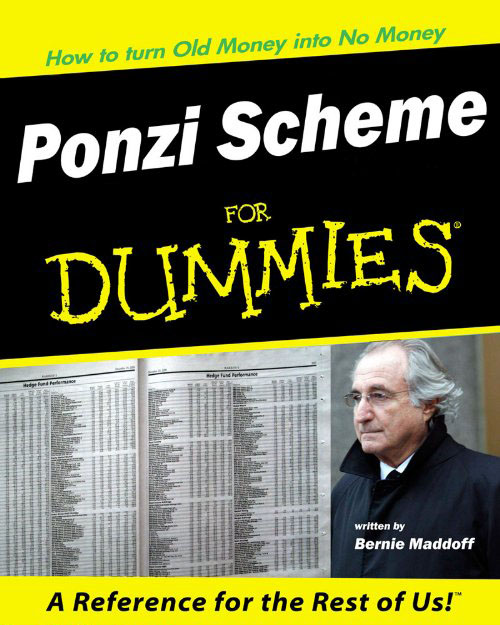
I’ve posted a few times before (here and here) about “affinity fraud” cases involving Latter-day Saints, that is, financial fraud cases that in part prey upon Mormons via their religion, much as Bernie Madoff’s frauds preyed heavily upon Jews and Jewish organizations.

Well, another example has cropped up:

Like those caught up in other get-rich scams — from Bernard Madoff’s $65 billion Ponzi scheme, which initially snared wealthy Jews, to an alleged $4.4 million fraud aimed at deaf people — Tri Energy’s investors had something in common. Many were Mormons and born-again Christians who shared dreams and prayers on nightly conference calls. They vowed to use the profits for charitable works and kept raising funds, at times taking out second mortgages, draining retirement accounts and recruiting relatives.

What’s interesting is that the people perpetrating the fraud aren’t LDS themselves — they’re just taking advantage of them:

Jones, Jennings and Simburg, none of whom is a Mormon, exploited this vulnerability for at least four years, offering a cocktail of spirituality, exclusivity and the promise of high returns.

“The guys who did this were geniuses in a way,” says Dana Carney, an assistant professor of management at the Columbia University Graduate School of Business in New York, who has written about investor psychology. “This has the flavor of a cult. They hit all these vulnerabilities. There was religion; we trust like people, especially religiously like people. With the nightly calls, there was an illusion of transparency. They took advantage of the sunk-costs phenomenon: The more people invest in something, the more connected they feel.”

Be sure to read the whole thing.  ..bruce..

Switch to Day Switch to Night